“AI should help staff communicate, not communicate for them.”Seema Adia - Deputy Head of Residential Operations at LSE
Nearly 750 student accommodation residents in the UK took part in the latest Youth Forum research from The Property Marketing Strategists (TPMS), and the headline findings set the tone for their recent panel on artificial intelligence in student living.
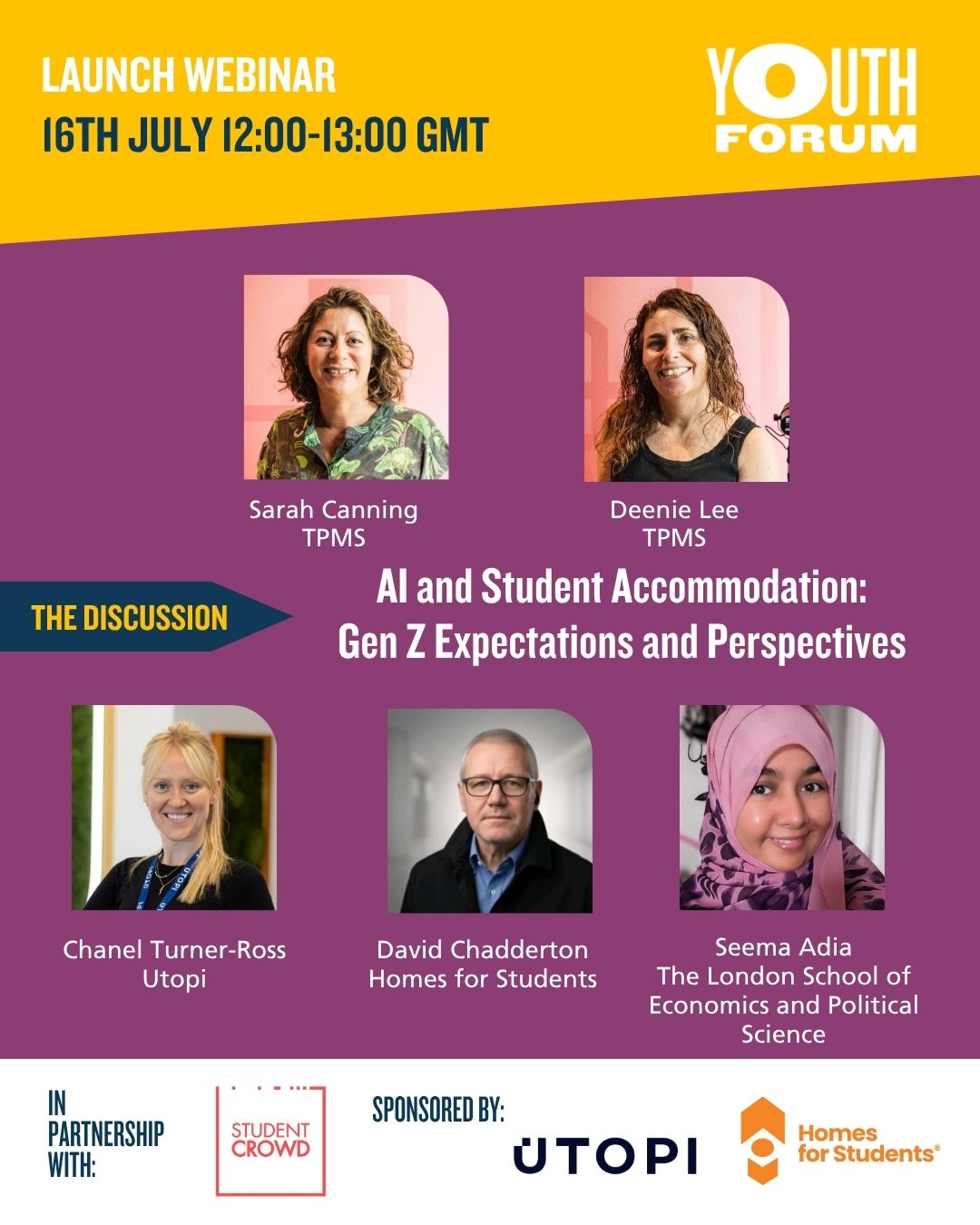
Chanel Turner-Ross, Marketing Director (Europe) at Utopi, joined TPMS co-founders Sarah Canning and Deenie Lee, as well as other guest speakers: Seema Adia, Deputy Head of Residential Operations at LSE, and David Cheletton, CMO of Homes for Students, Verve Life and Orla, to unpack what the survey results actually mean for the sector.
The headline results from the session included:
- 71% of respondents said they don’t fully trust AI
- 69% specifically distrust it on accuracy grounds
- 53% are concerned about its environmental impact
- 55% worry about its effect on jobs
- 26% of respondents already use AI whenever they can.
1. A Trust Gap, Not A Usage Gap.
The gap between adoption and trust, rather than a simple absence of trust, is the real story: Young people are using AI while remaining sceptical of it, which is a more complicated and more useful signal for the sector than blanket resistance would be.
Seema Adia brought an operational lens to that tension, describing how LSE trains staff to use AI for fast, accurate information across the student journey, while keeping an easy handoff to a person for anything needing judgement or empathy: “AI should help staff communicate, not communicate for them,” she said.
2. AI Should Enhance The Human Experience, Not Replace It.
For Chanel, that same principle applies well beyond the student-facing side of the business. “Good adoption of AI should enhance that human experience, whether that be productivity, communication, work,” she said, pointing to how embedded it has become internally at Utopi: “It’s so embedded in Utopi at the moment that I actually can’t really imagine doing our work, or having our department function, without it.”
3. The Environment & The Sceptics.
The environmental concern flagged by over half of survey respondents ties directly into what Chanel called a genuine ‘green paradox’: “Yes, the data centres powering AI tools use significant electricity and water, and that comes with a carbon burden and GHG emissions; but AI also has an immense capability to help reduce global emissions,” she said: “Look at AI enabled power grids, they can work in real time to draw in cleaner energy sources like solar and wind; so we need to start with awareness, and then build out strategies for sustainable use.”
David Cheletton brought a pragmatist’s counterpoint, framing trust as a wider human issue rather than something unique to AI, and pushing the panel toward results over process. “When the world goes one way, go the other way,” he said, arguing that speed and efficiency gains are there for operators willing to move first.
4. Where AI Could Go in the Future.
The strongest bridge between AI today in the PBSA sector and where it can go, is behavioural intelligence: “Use AI to analyse behavioural trends or occupancy trends and improve your understanding of how these residents are living and using these spaces,” Chanel said, describing how that understanding can shape everything from events programming to amenity use and asset performance. She also raised accessibility as an under-discussed resident benefit, from dictation support to legal and written help that residents might not otherwise reach amid ongoing cost-of-living pressure. “AI is also a very good tool for accessibility,” she said.
Deenie Lee’s read of the Youth Forum focus groups reinforced how deliberately students actually use AI. “They were keeping the use of AI to very specific tasks,” she said, mostly study and work, with a notable awareness of its limitations and echo chambers. Sarah Canning added a search-journey angle, describing AI’s current role in accommodation decisions as research rather than a booking or decision driver: “It’s just part of building up that knowledge bank before making a decision.”
Snapshots from the session, include:
- On AI enhancing the human experience: “Good adoption of AI should enhance that human experience, whether that be productivity or work…”
- On guardrails and data responsibility: “We’re in the game of data, so it’s so important for us to make sure that we have the right guardrails in place to make sure that people’s data isn’t being shared in ways that it shouldn’t be.”
- On Trust and Accuracy: “Our CTO, one of our co-founders, refers to it as a young child or a toddler. You probably want to supervise it, especially initially, until you can really trust it and it grows and matures.”
- On AI literacy: “Even if there is a fear or a worry about it, AI literacy is so important, you know, it’s better the devil you know than the devil you don’t, and I would encourage, even if people are worried about it, to at least try and expand that literacy.”
- On accessibility: “AI is also a very good tool for accessibility. You know, yes, there might be even better articulated complaints, but it’s also important to note that those residents got access to maybe legal support or legal knowledge for free. Accessibility is a really important thing in a world of inflation and costs and everything else.”
5. The AI Takeaway.
None of the panellists argued that trust in AI is a solved problem, and the Youth Forum data backs that caution up. But the direction of travel across every voice on the panel, operator, marketer and PropTech alike, was the same: AI earns its place in student living by enhancing the human experience, not replacing it, and by driving efficient, productivity and allowing teams to have more time back for the important tasks – engaging in person with residents.
The full Youth Forum report is available through The Property Marketing Strategists.