
true student specifies and operates to the highest brand standards: Modern fabric, efficient heat pumps, controls commissioned. Across three of their PBSA managed assets, room-level data from the Utopi platform reveals a truth that holds for every new-build: However well specified, energy drift and resident behaviour are always present. The only question is whether you can see them.

The Client.
true student is an award-winning, experience-led premium lifestyle brand, operating 5,000+ beds across the UK’s Russell Group university cities, with a proven track record of long-term value for partners. Wellbeing sits at the heart of every decision — which is why, across a new-build portfolio already designed for efficiency, they wanted full visibility and control of energy costs and performance without ever compromising the guest experience. Their partner of choice: Utopi
The Challenge.
On paper, a new-build PBSA scheme operated by true student is efficient by design: Strong fabric, high-spec glazing, every box ticked. What the spec sheet cannot capture is what happens after residents move in, and the effect that has on energy performance and cost, across a single asset or an entire portfolio. Windows opened with the thermostat too high. Rooms left empty with the heating running. Normal behaviours that no design standard can predict.
This is drift, and it exists in every occupied building, new or old. It never shows up on a GRESB or BREEAM certificate, but it shows on the operational cost lines. It only becomes visible through quality, room-level data, measured continuously, room by room. For true student, seeing it was the first step to acting on it, proactively.
The Utopi Solution.
Utopi Multisensors were installed in every room across three true student assets, giving a granular, continuous read on how each building performed in real time. Over a three-year period, this let true student baseline consumption and build a clear picture of their energy performance. So when the opportunity came in 2026 to upgrade further with PanelSync, they took it.
PanelSync upgrades standard electrical panel heaters into smart, Utopi-controlled heating devices. A simple module change retrofits older units into energy-reducing technology, whether new-build or retrofit. Working quietly in the background, PanelSync reduces excessive energy consumption, turns off heating in unoccupied spaces, and cuts energy drift at scale across a portfolio.
The Data.
The data shows what a well-built asset looks like when drift goes unmanaged, comparing the first asset with PanelSync installed against those without:
Above 24°C, Site 1: 15.7%
Above 24°C, Site 2: 4.5%
Above 24°C, Site 3 (PanelSync): 1.7%
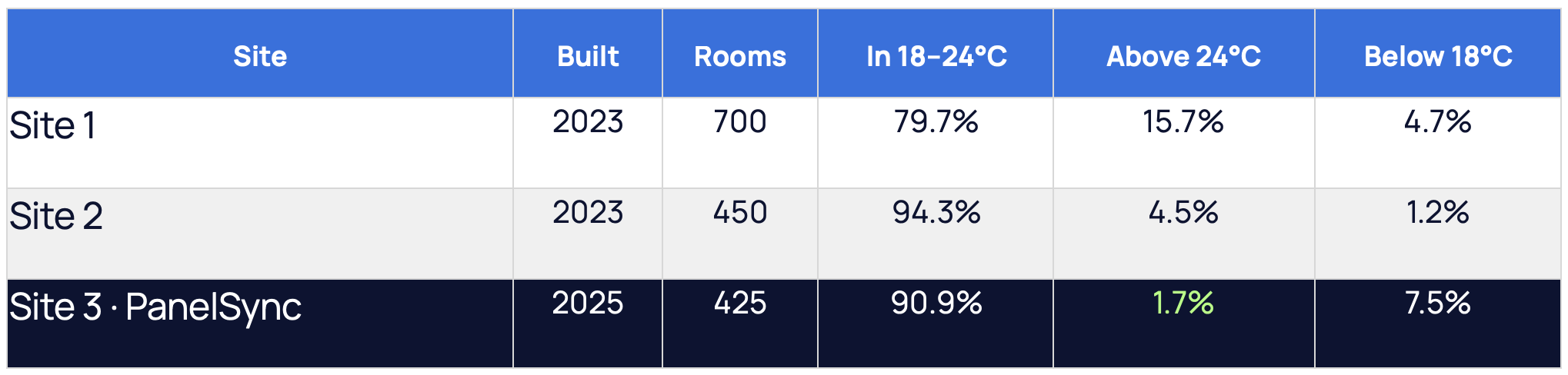
At above 24°C, Site 3 sits at 1.7%, against 4.5–15.7% at the other two sites. Its higher below-18°C share, 7.5%, is not comfort lost: It is PanelSync working quietly in the background, stepping unoccupied rooms down rather than heating an empty bed. Same quality build, same weather, a fraction of the drift.
PanelSync will now be rolled out across the rest of the portfolio.
The Seasonal Impact.
A further true student managed site, 1,000 beds at 80% occupancy with electric heating and not yet fitted with PanelSync, makes the same point a different way. Averaged across the year, it runs at 21.5°C: A healthy-looking number for a well-built asset.
But it is only an average, and averages hide exactly the drift that room-level data is built to catch.
- Summer 2025: Electricity use ran at or below the high-performance benchmark, proof the building and its systems perform exactly as specified.
- Winter peaks (Nov, Jan ’25, Jan ’26):6–10.3 kWh / bed / day, well above even the low-performance benchmark for comparable sites, as resident behaviour and colder weather combine.
- 6% of rooms ran above 24°C in winter: A seasonal, resident-behaviour pattern, not a fixed design limitation. This site’s PanelSync retrofit is next on the schedule, to keep that drift in check the way it already is at Site 3.
Portfolio averages hide the rooms that matter. 21.5°C across a site can mean every room sitting comfortably, or a fifth of them running too hot while the rest run cold. Room-level data gives that level of detail, on a new-build asset just as much as an older one. That is the real value: Not a guarantee that drift won’t happen, but a live, granular picture of exactly where it is, so it can be acted on before it costs you. PanelSync then keeps that drift to a minimum, quietly, in the background.