“The technology gives us useful control and visibility, but the key lesson is that technology alone does not deliver the outcome. The improvement came from bringing Utopi and the site team together, reviewing the data and acting on the findings.”Jan Germs, ESG Manager - Europe at Mapletree

The Client.
Mapletree is a global real estate investor, developer, capital and property manager. Within its UK student housing portfolio, Mapletree and its wholly owned student housing operator, Student Castle, have been working with Utopi to explore how smart heating controls, improved data and stronger site engagement can reduce energy consumption while maintaining resident comfort.
The Challenge.
The 2025/26 heating season started well. Compared to the same months in the previous year, energy consumption at one asset decreased by 14.4% in October 2025 and 8.1% in November 2025, respectively. This provided an encouraging indication that lower consumption could be achieved, although further monitoring was needed to understand the drivers and confirm whether the improvement could be sustained.
Consumption subsequently increased slightly year-on-year (y-o-y) in December 2025 and January 2026, by 1.9% and 0.9% respectively. Rather than treating the y-o-y increase as an isolated variance, Mapletree and Utopi took the opportunity to conduct a more detailed operational review.
The Reset.
In February 2026, Utopi’s Impact Team, Mapletree, Student Castle and the site team reviewed performance together and agreed a targeted improvement plan. The review combined data analysis with site-level operational knowledge to identify practical, operational actions that could be incorporated into the site team’s existing processes.
The improvement plan comprised two key changes:
1. Faster temperature step-down in unoccupied rooms.
Heating step-down settings were tightened so empty rooms cool down sooner:
- Before: No motion for 2 hours → step down to 18°C, no motion for 12 hours → step down to 14°C
- After: No motion for 1 hour → step down to 18°C, no motion for 3 hours → step down to 14°C
2. Weekly reporting on rogue heaters.
Utopi began sharing a weekly rogue heater report with the site team so they can use the information to investigate rooms and manage heaters operating outside the intended control strategy.
The Results.
Following the reset meeting and the implementation of the improvement plan, electricity consumption was reduced y-o-y in February, March and April 2026:
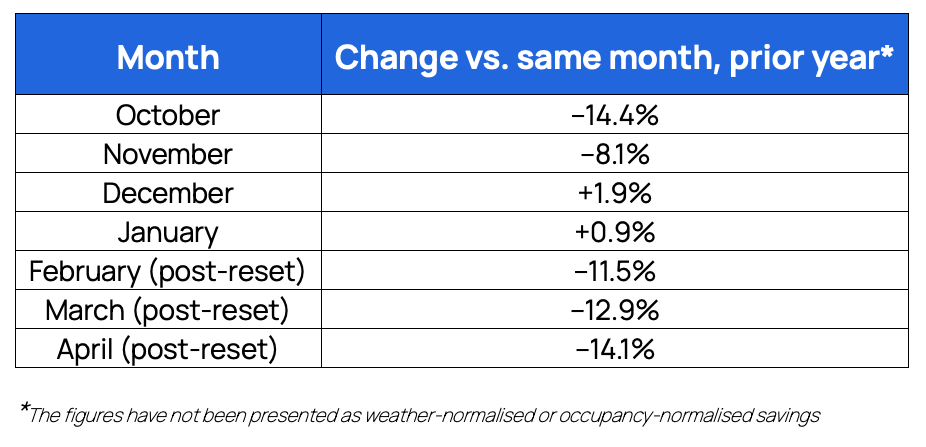
Across the three months following the reset, the asset used approximately 12.8% less electricity compared to the corresponding period in the previous year. This represented:
- an observed reduction of ~77,000 kWh across the three-month period
- cost savings of ~£43,000 (at £0.25/kWh) across the 200-day heating season
The case study demonstrates that smart heating controls and data analysis can improve energy performance when combined with appropriate settings, clear operational ownership and timely action by site teams. It also highlights the importance of reviewing existing processes and identifying areas for improvement to reap operational and cost benefits.
Mapletree, Student Castle and Utopi are building on this approach through recurring performance reviews across the wider portfolio. These reviews will consider control settings, exceptions, equipment availability, resident comfort, operational issues and opportunities for further optimisation. Continued monitoring will be needed to determine whether the improvement is sustained over future heating seasons.