
“The RICS (Royal Institution of Chartered Surveyors) has published the 4th edition of its global professional standard on ESG in commercial property valuation, effective from 30 April 2026. It mandates that environmental, social, and governance (ESG) factors be systematically integrated into valuations, shifting from discretionary reporting to mandatory assessment of sustainability risks and value drivers.”Royal Institute of Chartered Surveyors (RICS)
How Utopi helps clients meet the RICS ESG and Sustainability in Commercial Property Valuation standard (4th edition, effective 30 April 2026).
What has Changed.
The Royal Institution of Chartered Surveyors (RICS) has published the fourth edition of its global professional standard on ESG and sustainability in commercial property valuation. Effective from 30 April 2026, it applies to all RICS members and regulated firms undertaking commercial property valuations worldwide.
This is not a minor update. The standard moves ESG consideration from advisory guidance to a mandatory professional requirement, embedded within the RICS Red Book Global Standards and the International Valuation Standards (IVS). Valuers are now required to actively investigate, evidence and report on ESG factors where these are significant to the valuation.
The Bottom Line for Clients –Assets without accessible, structured ESG data are now at a material disadvantage at valuation. If a valuer cannot evidence ESG performance, they cannot reflect it positively in the valuation. The burden of proof sits with the asset. |
What the Standard Requires.
The 4th edition sets out a clear framework across six core areas:
- ESG KPI data collection and reporting – a consolidated global list of key performance indicators, covering energy, carbon, water, waste and social factors, must inform valuation advice.
- Evidence-based valuations – certification schemes (EPC, BREEAM) are no longer sufficient on their own. Operational performance data is required to substantiate any ESG adjustment.
- Capital and operational expenditure assumptions – valuers must now consider the cost of achieving or maintaining ESG performance, and ESG-linked opex reductions can be formally reflected in valuation.
- Green leases and income efficiencies – sustainability credentials that support stronger rental bids, occupier retention and income resilience must be evidenced at asset level.
- Physical climate risk – the standard requires valuers to assess whether physical risks (flooding, overheating, storm exposure) are relevant to the asset.
- Jurisdictional compliance – for UK assets, this means evidencing compliance with Minimum Energy Efficiency Standards (MEES) and trajectory towards future thresholds.
Where Utopi Directly Addresses the Standard.
- ESG KPI Data: The Foundation of the New Standard
The standard requires that data from property performance systems and metrics must inform the valuation where relevant. For the first time, a consolidated global KPI list covers energy consumption, carbon output, water use, waste and social performance.
Utopi collects and structures exactly this data, continuously, at asset level. With 50 billion data points across over 78,000 beds, Utopi clients hold the evidence base that valuers now need. Those without it cannot demonstrate ESG performance, only claim it.
- Moving Beyond Certification
The standard is explicit: certifications such as EPC ratings or BREEAM scores should not be the sole determinative of a valuation adjustment. Operational performance data is required to substantiate any claim.
Utopi provides the granular, time-stamped performance data that sits beneath certification: actual energy consumption, heating efficiency, temperature regulation and carbon output. This is the evidence that turns a certificate into a credible valuation input.
- Evidencing Opex Reduction for Valuation Uplift
For the first time, the standard provides clear guidance on how operational expenditure linked to ESG factors may be reflected in valuation. Lower energy costs, evidenced at asset level, can now formally contribute to valuation upside.
Utopi’s smart temperature control and energy management platform directly reduces operational costs. With a validated 9x return on investment, Utopi clients can present hard evidence of ESG-linked opex reduction: the precise input valuers need to reflect this in their assessment.
- Supporting Green Leases and Occupier Retention
The standard recognises that sustainability credentials influence rental bids and that green leases are increasingly accepted by tenants as fulfilment of their own ESG obligations. This gives landlords a direct commercial incentive to evidence building performance.
Utopi resident engagement tools and performance reporting demonstrate to occupiers that a building delivers on its sustainability commitments. This strengthens the landlord’s position in lease negotiations, supports higher and more resilient rents, and improves occupier retention.
- Physical Climate Risk Monitoring
The standard broadens its scope on physical climate risk, requiring valuers to assess whether risks such as overheating, flood exposure or energy vulnerability affect the asset.
Utopi’s continuous monitoring of building environment data creates an asset-level baseline over time: temperature profiles, energy demand patterns and efficiency trends that can surface early indicators of physical risk vulnerability and support the valuer’s assessment.
- UK Regulatory Compliance: MEES and EPC Trajectory
For UK assets, the standard requires evidence of compliance with Minimum Energy Efficiency Standards and a clear trajectory towards future thresholds. This is not just a regulatory obligation: it is now a direct input to valuation.
Utopi helps clients improve EPC ratings and achieve asset-level certifications by delivering the energy efficiency improvements and supporting data that underpin them. Clients with Utopi installed are better placed to evidence MEES compliance and demonstrate continuous improvement.
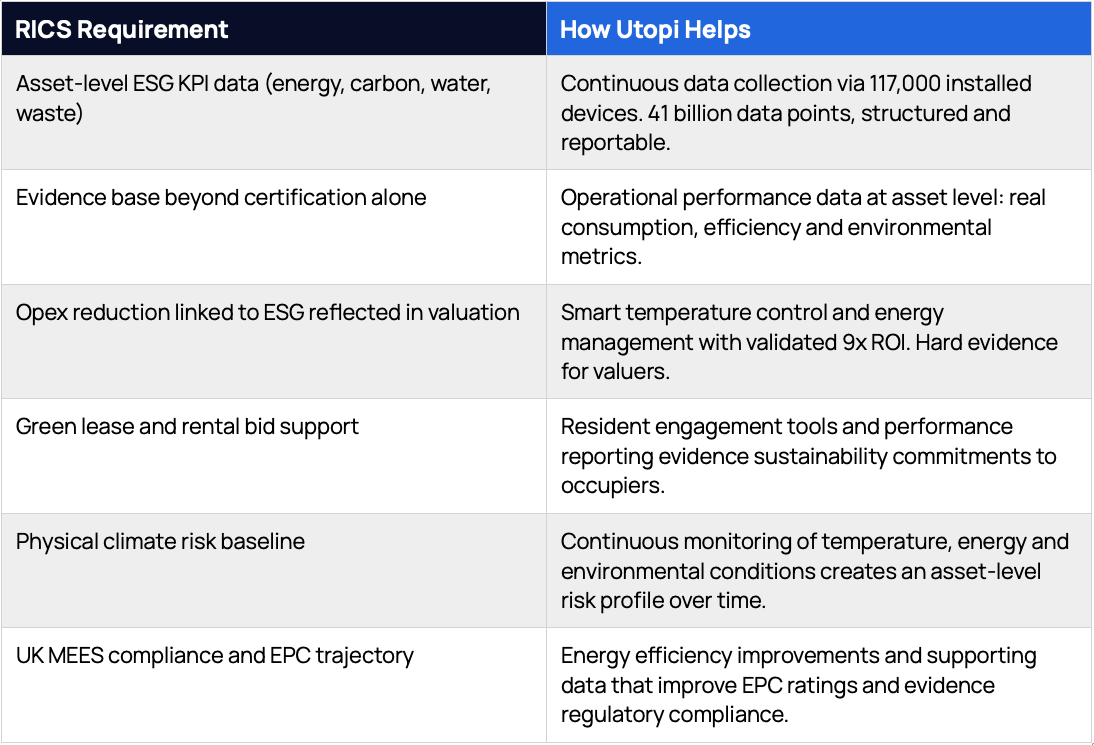
Cheat Sheet: RICS Requirements and How Utopi Helps.
The Market’s Biggest Challenge.
During the RICS consultation process, ESG data availability, management and verification emerged as one of the most contested themes. The market does not lack willingness to engage with ESG: it lacks access to reliable, asset-level data.
This is the gap Utopi was built to close. Low-cost wireless installation that works in old and new buildings. Automated data collection at scale. A platform that turns raw building data into structured, reportable ESG intelligence.
Valuers need the data. Lenders and investors are increasingly requiring it. Clients with Utopi installed have it. Those without are at a measurable disadvantage.