
“AI offers the real estate sector a chance to think bigger than efficiency. It allows us to design for planetary constraints, demographic shifts and climate realities simultaneously — and to do so proactively rather than reactively. If we approach AI with ethical discipline and long-term intent, it can help transform the built environment from a passive asset class into an active participant in solving some of society’s hardest problems. ”Dex Hunter-Torricke - Engine Associates
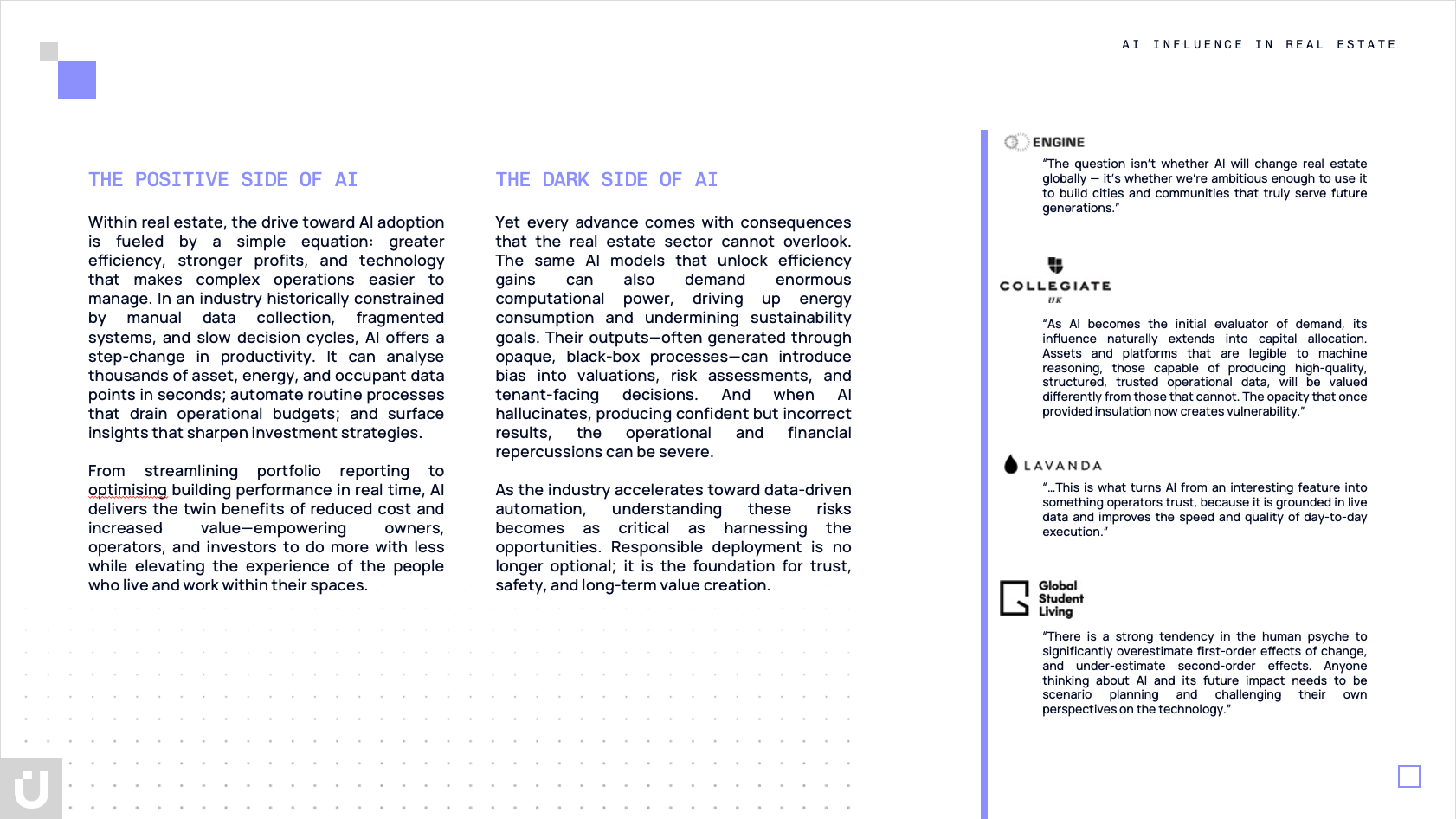


Utopi’s latest White Paper: ‘The AI Influence in Real Estate – Are we moving to the Dark Side?’
Artificial intelligence is rewriting the rulebook — and the real estate sector now finds itself at the center of a technological revolution. With AI projected to contribute up to $15.7 trillion to the global economy by 2030, its impact is already visible across industries, from the conversational breakthroughs of ChatGPT to the fan-experience and performance analytics innovations at Hearts Football Club. For real estate, the implications are transformative: predictive maintenance, energy optimisation, ESG performance enhancement, and powerful scenario simulations that strengthen yields, resilience, and long-term asset value. But AI is not a monolith. While machine learning focuses on pattern recognition and prediction, AI encompasses a broader suite of capabilities —from natural language reasoning to autonomous decision-making — unlocking far greater potential, but also far greater responsibility.
This white paper explores both the promise and the peril. We examine where AI delivers measurable value today, demystify its core concepts, and outline the guardrails organisations must establish to deploy it safely and ethically.
You will learn how leaders across sectors are already leveraging AI for competitive advantage, what Utopi’s approach enables within the built environment, and how to navigate the risks — from energy-intensive training models to biased outputs and hallucinations.
The message is clear: AI can be real estate’s most powerful asset, but only if adoption is matched with accountability.