
Data inconsistency and “data debt” are the greatest technical barriers to AI adoption in multi-tenant real estate, with a Warwick Business School report identifying lack of accessible, high-quality data as a major stumbling block hampering the PropTech revolution across UK markets.
Two key industry events have covered this topic of AI, PropTech Connect’s roundtable in May 2025, captured in Going AI-First: A Practical Guide for Decision-Makers, and GSL’s Investor Summit in October 2025, captured in the keynote speech entitled ‘AI or Die’. What was surfaced in these talks reflects what many in the industry already know: the barriers to AI in real estate aren’t primarily technical. Data fragmentation, siloed systems, and inconsistent processes create friction that no algorithm can solve on its own. These challenges are especially relevant in multi-tenant buildings, where information flows across multiple stakeholders, each with their own systems and priorities.
The gap between AI’s potential and its practical deployment in real estate comes down to a foundational issue: data quality. Without clean, consistent data, even the most sophisticated AI tools struggle to deliver reliable insights. Building performance metrics, ESG reporting, and resident services all depend on data that is accurate, accessible, and structured in ways that different systems can understand.
The question then becomes: what does a practical approach to solving these data challenges actually look like in practice?
What the events made plain
The PropTech Connect report distilled six clear truths:
- Most firms’ rate AI maturity at around 3–5/10: interest is high, readiness is not.
The sector’s operational complexity (many asset types, legacy systems, lots of silos) slows adoption. - Data inconsistency and “data debt” are the greatest technical barriers.
Trust, governance and a human-in-the-loop approach are essential to get people to use AI. - Upskilling and change management are strategic, not tactical, activities.
Where data is fixed, AI becomes an accelerator for faster transactions, smarter operations and better ESG outcomes.
The GSL keynote distilled additional clear truths:
- Human is the new luxury – AI can drive efficiency but use that time to reinvest in the human experience.
- Data is your Moat – AI is only as powerful as your data, so start now because you will never regret having improved data-systems.
- Key industry names might not know what the future will bring for AI, but one thing is true today – Data empowers, triggers learnings, and ensures we all benefit long term.
Where most AI projects stumble, and what to do instead
The PropTech Connect report also calls out three recurring failure modes: (1) poor baseline data; (2) risky, ungoverned pilots; and (3) top-down mandates that breed fear. If you’re planning an AI initiative, we suggest treating these as solvable engineering and people problems, not inevitabilities.
- Fix the data layer first. AI models and analytics are only as useful as the inputs they receive. A clean, normalised, room-level dataset allows rapid experimentation, far better benchmarking and far less operational risk.
- Start with low-regret use cases. The roundtable recommends beginning with data collection, plausibility checks and automated reporting (the “small wins” that build trust).
- Govern experimentation, empower employees. Bottom-up innovation is powerful, but it needs guardrails. Create a simple governance model (who owns which datasets, who can run which experiments, how outputs are validated) and combine it with user-facing tools that make everyday operations easier.
The Human Touch
“Humans tend to be more tolerant of mistakes made by other humans, but far less tolerant when those mistakes are made by AI.” Limor Shklaz from Nuveen.
Trust emerged as critical for successful human-AI collaboration. There are several strategies to build it:
- Keep humans in the loop for important decisions
- Provide clear explanations for AI outputs, what changed, why, and who authorised it
- Start with low-regret tasks like automated data entry to demonstrate consistent performance and allow the “adoption muscle” to grow
The goal isn’t to replace human judgment but to augment it. AI can rapidly analyse market data, but a human asset manager will craft the investment strategy. AI can handle predictive maintenance scheduling, but as Aaron Bailey noted: “AI won’t do the physical maintenance task – a human is.”
The next step… UtopAI
UtopAI is the next step in our mission to deliver innovative, reliable, and valuable outcomes for our global client base; and all with intelligence at its core. Seamlessly fitting into existing workflows, UtopAI will connect via The Utopi Platform and via API and Model Context Protocol to other AI tools, ensuring flexibility and scalability.
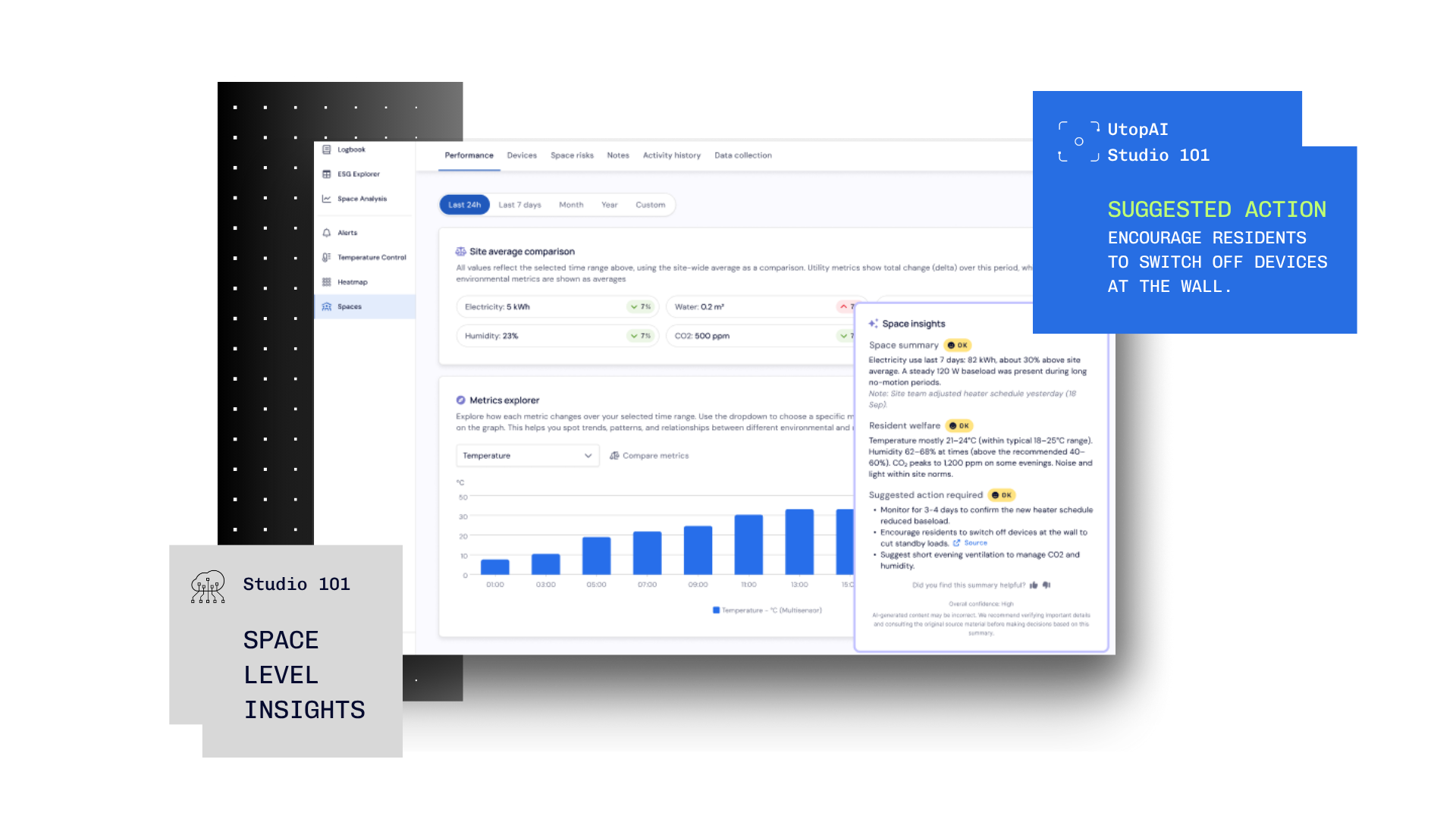
What to Expect:
AI Insights in The Utopi Platform
UtopAI will include AI insights within The Utopi Platform. It doesn’t just present data, it interprets it. It detects patterns, predicts inefficiencies before they escalate, and captures trends you might never have spotted manually. Allowing you to interrogate and contextualise your insights as you work.
AI Insights via API / MCP Integration
Think of it as the intelligence layer turning asset data into strategic advantage, UtopAI will also include an API extension. Allowing you to interrogate the data via existing workflows and tools – streamlining operations and driving productivity.
We don’t believe in AI for AI’s sake. That’s why UtopAI is built with guardrails: it never fabricates data or generates plausible-sounding answers without evidence. Every insight is traceable to actual building performance data, every recommendation is grounded in measured outcomes. Data protection is designed into the architecture from the start, not bolted on as an afterthought. Our priority isn’t to showcase what AI can do, it’s to deliver what building operators actually need: accurate insights, actionable recommendations, and the confidence that the system won’t make claims it cannot substantiate. Utopi’s approach starts where the industry needs it most, at the data layer, ensuring that when AI does enter the picture, it has a foundation it can actually build on.